
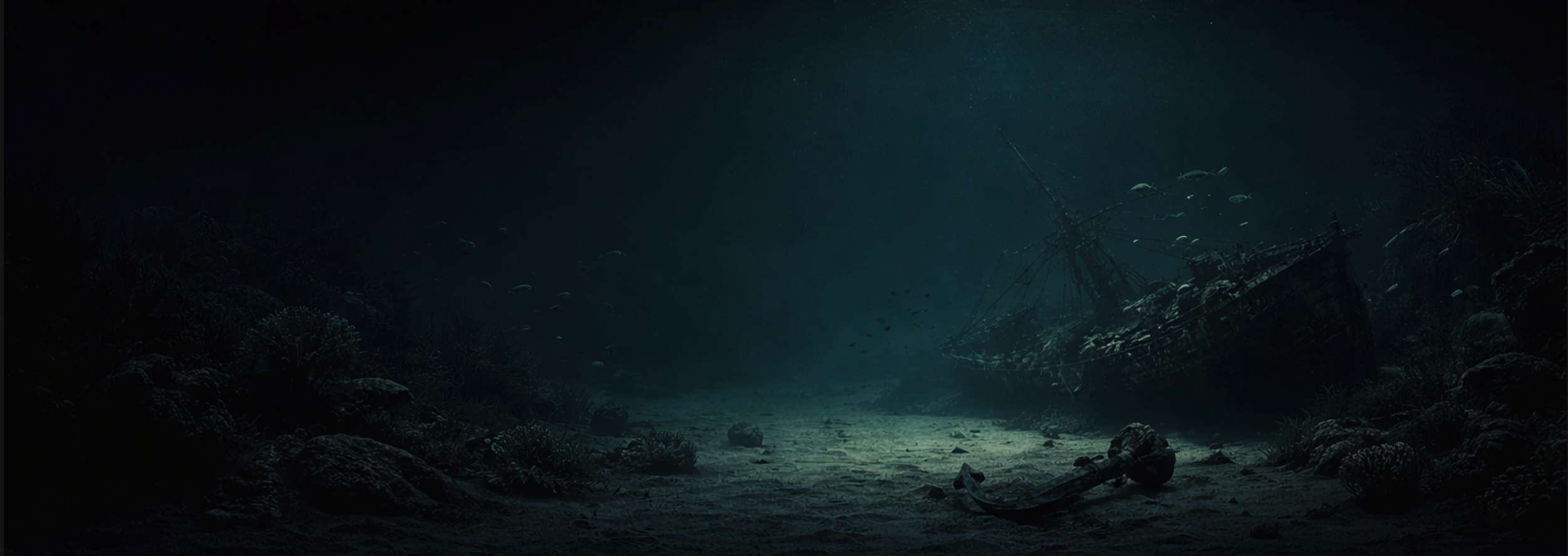
MOLASSES REEF:
WHERE STORIES SETTLE
Just off the coast of Providenciales in the Turks and Caicos Islands lies Molasses Reef — a site of quiet significance beneath otherwise calm, clear waters.
At the surface, the sea appears effortless. Shallow banks, shifting light, and long stretches of turquoise give little indication of what lies below. But beneath this clarity is a place shaped by movement, unpredictability, and time.
For centuries, these waters sat along important maritime routes connecting Europe, the Caribbean, and the Americas. Ships passed through regularly, navigating reefs, currents, and sudden changes in weather. Not all made it through.
Molasses Reef has become one of the most historically important underwater archaeological sites in the region, home to shipwrecks spanning centuries. Each one reflects a different moment — not only in history, but in the conditions of the sea itself.
1513 — LA PRIMERA
Calm. Clarity. The beginning.
Inspired by one of the earliest known European-era wrecks in the Americas, dating to the early 1500s, this moment reflects a time when these waters were still being explored and understood.
Conditions were not defined by chaos, but by unfamiliarity. Navigation was imprecise. The reef itself, largely uncharted. The sea, while not violent, demanded respect.
The result was quiet and absolute.
This moment is interpreted through the rum it inspires — composed, clear, and structured. A profile shaped by restraint rather than force. A beginning defined not by intensity, but by precision and balance.
1837 — ESPERANZA
Movement. Tension. Transition.
By the early to mid-19th century, these waters were more frequently traveled, but no less unpredictable. Trade had increased. Routes were better known. But the environment remained in control.
Shifting conditions, building pressure, and unstable weather patterns created moments where control gave way to circumstance. The sea moved differently — less forgiving, more dynamic.
This planned expression draws from that sense of tension. Not yet at its most extreme, but no longer calm.
1887 — SLOBODNA
Depth. Power. Complexity.
By the late 19th century, ships were stronger. Navigation had improved. But the sea remained unchanged.
This expression is inspired by the more intense and forceful conditions often encountered in deeper waters — stronger currents, greater unpredictability, and environments shaped as much by time as by impact.
What remains is transformed not only by the event itself, but by what follows. Pressure, depth, and time reshape everything.
The planned expression carries that same weight — deeper, more structured, and more complex. Not chaotic, but powerful. A composition shaped by intensity and refinement over time.
1841 — THE TROUVADORE
History. Humanity. Legacy.
Among the wrecks associated with Molasses Reef, the Trouvadore holds a distinct and important place.
A Spanish slave ship that wrecked in 1841, its story extends beyond maritime history into the broader narrative of the Caribbean. Those on board survived and made their way to East Caicos, where their legacy remains part of the cultural fabric of the islands today.
The Trouvadore represents not only a moment at sea, but a human story of resilience, survival, and continuation.
This legacy is honored through Bambarra Trouvadore Rum, a tribute that connects past and present, acknowledging the deeper history tied to these waters.
A REEF DEFINED BY LAYERS
Molasses Reef is not defined by a single event, but by accumulation.
Different centuries. Different ships. Different conditions. Each one shaped by the same environment, yet each resulting in a different outcome.
Calm. Movement. Intensity. Depth.
These are not just characteristics of the sea. They are the foundation of Molasses Reef as a rum.
Each expression draws from these moments — not to recreate them, but to interpret them. To capture the feeling of those conditions, and translate them into something you can experience.
Beneath the surface, everything leaves a trace.
Molasses Reef is where those traces remain.